
AI Tools for Blogs That Help You Plan Schedule and Publish With Ease

Running a blog is hard work, but AI tools can make it simpler. These tools help you:
- Plan smarter: AI identifies trending topics, analyzes gaps in your content, and predicts audience interests.
- Write faster: AI drafts posts, optimizes for SEO, and refines tone to match your style.
- Publish efficiently: Automate scheduling and format content for blogs, social media, and more.
- Track performance: Use AI analytics to monitor engagement, trends, and even AI tool visibility (GEO).
- Save time: Bloggers save hours by automating repetitive tasks.
With AI, you can focus on creating quality content while tools handle the rest. Whether you’re struggling with consistency, idea generation, or managing multiple platforms, AI offers practical solutions to grow your blog and audience.
AI Automation with Make: Create an Automated Blog Post Generator
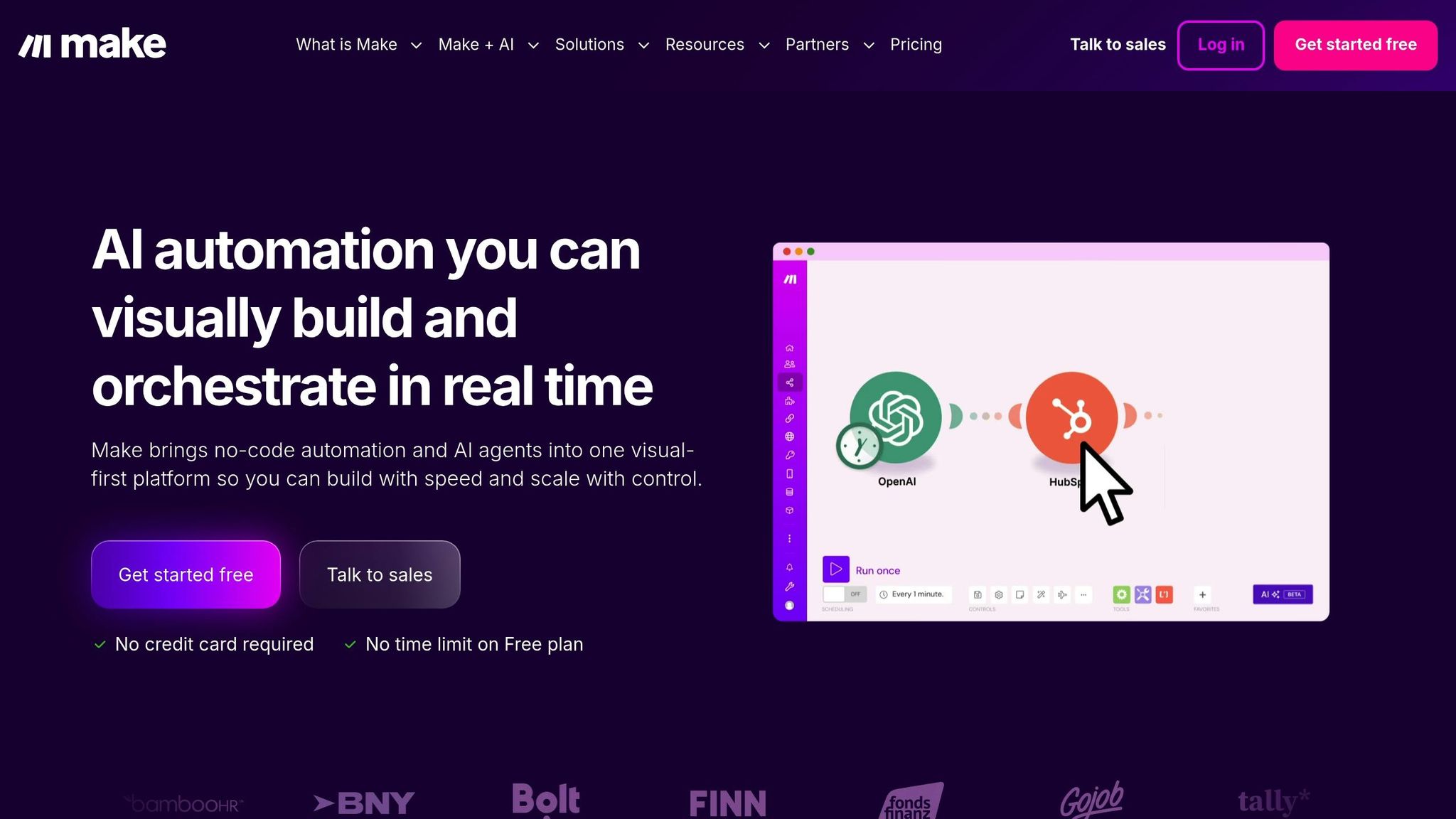
Why Blogging Automation Saves Time and Improves Results

AI Blogging Tools: Time Savings and Performance Statistics
Blogging isn't just about writing - it’s a juggling act of formatting posts, managing deadlines, tracking performance, and sharing content across platforms. On average, bloggers spend 6–8 hours per post handling these repetitive tasks [6]. That’s almost an entire workday dedicated to a single piece of content.
AI automation simplifies this process by tackling the time-consuming tasks for you. Instead of manually scheduling posts or reformatting content for platforms like WordPress, Medium, and social media, automation tools distribute everything from one central hub. The impact? Agencies using AI automation save over 10 hours each week on content management [7].
But it’s not just about saving time. AI tools also enhance engagement and consistency. Users of AI-driven blogging platforms report a 59% average boost in engagement [7]. These improvements set consistent bloggers apart from those who struggle to keep up.
Common Blogging Problems AI Tools Solve
AI tools don’t just save time - they address many of the challenges that come with manual blogging.
One common issue is irregular posting schedules, which can erode audience trust. If readers don’t know when to expect your next post, they may stop following altogether. AI content calendars solve this by automatically scheduling posts based on audience activity patterns. They also send reminders for draft deadlines and review checkpoints, ensuring you stay on track [5].
Another challenge is generating fresh ideas. After a while, it’s easy to feel stuck, staring at a blank screen or recycling old topics. AI trend analysis tools scan vast amounts of data daily, identifying emerging topics weeks before they peak. This gives you a head start in creating content that’s timely and relevant.
Managing multiple platforms manually can also be a headache. Copying, pasting, and reformatting content across blogs and social media drains time and energy. Automation tools eliminate this by distributing approved posts to all connected platforms simultaneously, ensuring a consistent presence without the hassle [5].
Measurable Benefits of AI Blogging Tools
The advantages of AI tools are clear in the numbers. In 2024, 82% of marketers created more content than the previous year, yet only 37% saw their budgets grow proportionally [8]. Automation helps bridge this gap by reducing drafting time by 80–90% [8], allowing you to produce more content without increasing costs.
Quality doesn’t have to take a hit, either. Automation handles tasks like drafting, formatting, and SEO optimization, freeing you up to focus on injecting your unique perspective and ensuring accuracy. A practical tip? Add a "flex slot" to your content calendar - reserve one monthly spot for breaking news or trending topics identified by AI [5]. This keeps your content fresh without disrupting your overall schedule.
Cost savings are another major perk. By maintaining a steady publishing schedule without hiring extra help or working overtime, you lower your cost per post while increasing output. For many bloggers, the savings from automation offset the initial investment within weeks, especially for those who previously struggled with consistency.
How AI Helps Plan Your Blog Content
AI takes the guesswork out of blog content planning, turning it into a precise, data-driven process. Instead of relying on manual methods that often involve trial and error, AI leverages real-time search and engagement data to uncover exactly what your audience wants to read.
For instance, AI can perform a content gap analysis, comparing your existing posts to industry trends and audience search queries. This reveals topics you haven’t covered yet and even tracks competitor performance to highlight underexplored areas in your niche [6][10]. By addressing these gaps, you can position yourself as a leader in your field, offering fresh perspectives rather than rehashing what’s already out there.
Struggling to come up with ideas? AI can help here too. For example, you can prompt it to generate a list of 15+ thought-provoking questions about your topic [3]. These questions often uncover unique angles that your competitors might have overlooked, giving your blog a distinct voice.
Finding Topics and Trends with AI
AI doesn’t just suggest topics - it identifies trends before they become mainstream. Tools like Pressmaster.ai, which scans over 500,000 data sources daily, can spot emerging trends weeks in advance [6]. This early insight gives you the chance to create content while the topic is still gaining traction, not after it’s already oversaturated.
Here’s how it works: AI analyzes search volumes, social media chatter, forums, and news articles to detect rising topics. When multiple signals point to a trend, the system flags it and even suggests angles that align with your audience’s interests. This way, you’re not just following trends - you’re tailoring them to your readers.
AI also excels at digging into niche forums like Reddit, Quora, and LinkedIn [9]. These platforms often reveal specific pain points and questions that broader tools miss. By analyzing thousands of forum threads, AI extracts recurring themes and frustrations, which can serve as the foundation for compelling blog posts.
Another creative method is using voice-to-strategy workflows. Simply record your spontaneous ideas about a topic, and AI can transcribe and organize them into polished outlines [3]. This approach captures your unique perspective while structuring it into a professional content plan.
Building a Content Strategy with AI
A solid content strategy goes beyond a simple list of topics. It’s about aligning what you publish with what your audience genuinely wants to read. AI makes this alignment possible by studying audience behavior and engagement data across your existing content.
For example, AI can analyze which of your posts get the most shares, comments, and time spent on the page. Using this data, it identifies patterns in what resonates with your audience and what doesn’t. From there, it recommends topics, formats, and even publishing schedules that match their preferences. This isn’t guesswork - it’s based on actual behavior.
AI also ensures your strategy aligns with search intent by analyzing high-impact keywords and search trends [10]. This means your content is more likely to appear when people are actively looking for answers, increasing its visibility and relevance.
"AI-driven behavioral targeting is the digital equivalent of a hyper-focused salesperson and it promises tailored experiences." - Adam Fard, Co-founder & Head of Design [12]
Beyond analyzing past data, AI can also predict future trends through predictive content planning. By forecasting shifts in audience interests, it helps you stay ahead of the curve, ensuring your content remains timely and engaging [6].
One effective framework AI supports is the pillar-and-cluster model. Start by identifying 3–5 core "pillar" topics that represent your niche, then generate 8–12 related "cluster" subtopics for each pillar [13]. For example, if your pillar is "content marketing", clusters might include "email marketing", "social media strategy", and "SEO basics." This approach ensures comprehensive coverage while maintaining a clear focus.
To make your strategy even more tailored, feed AI with specific market data, customer engagement metrics, and your brand voice guidelines [11][12]. By consolidating notes, transcripts, and links into a single document, you can ask AI to identify recurring themes and key questions. This “dump document” approach turns scattered ideas into a cohesive strategy.
For ongoing success, establish a weekly calibration cycle. This involves reviewing AI-generated trend reports and adjusting your content calendar based on the latest performance data [13]. Dynamic calendars that adapt in real-time ensure your strategy stays relevant, even as audience preferences and trends evolve.
Creating Blog Content with AI
AI doesn't just assist in planning - it actively helps craft your content. Modern AI tools can take your ideas, style preferences, and brand guidelines and transform them into polished drafts that align with your vision.
The process begins with setting the right context. Gather your notes, transcripts, or even social media posts into a single document, and let the AI analyze them. This helps identify gaps in existing viewpoints, allowing you to approach topics from a fresh angle [9]. To fine-tune the output, you can also set "negative constraints", such as avoiding overused phrases like "In today's world", ensuring your content remains sharp and to the point [9].
Once a draft is ready, refining it is key. AI tools can adjust the language, align the tone with your brand, and even generate catchy headlines and meta descriptions [9]. To test if your draft has a unique perspective, ask the AI to summarize it in a few sentences. If the summary feels dull, it might be time to add more specific data or rethink the angle [9].
Writing Blog Posts with AI
AI takes the drafting process further by streamlining each step, helping you create content that's engaging and relatable. The journey starts with research and topic discovery. AI tools can scan platforms like Reddit and LinkedIn to uncover audience pain points and frequently asked questions [9]. This ensures your content addresses what people genuinely care about.
Next is context-rich outlining. By providing the AI with specifics - such as your audience's challenges, gaps in existing content, and your brand's perspective - you can generate high-quality outlines [9]. Avoid vague prompts like "write a blog post." Instead, share a few writing samples to teach the AI your preferred tone and structure [9]. This step ensures the output mirrors your voice, making it feel authentic.
AI also supports verification and packaging. Tools like Pressmaster.ai come equipped with features like plagiarism detection, fact-checking, and even AI detection to ensure your content is both original and accurate. Additionally, its AI Humanizer feature adds depth by incorporating emotional elements and personal anecdotes that standard AI might miss [14][4]. These checks safeguard your credibility while maintaining your unique style.
One standout feature is the ability to transform interviews into articles. Pressmaster.ai's conversational interview mode allows you to speak naturally, and the AI organizes your insights into a polished draft. As Todd Sivers, a SaaS and AI tester, shared:
"It doesn't write so much as it reorganizes my own words for me. I love the experience of the interview it does to pull information from me." - Todd Sivers, SaaS & AI Tester [2]
This approach ensures your voice and perspective remain intact while structuring your ideas into a professional, reader-friendly format.
Getting Input from Team Members and Experts
AI's collaborative features make it easier than ever to incorporate insights from team members or subject matter experts (SMEs). Instead of scheduling lengthy meetings or manually transcribing notes, AI streamlines the process. With external interview links, experts can answer AI-generated adaptive questions, which are then transcribed and enriched into a polished draft. This means experts can share their knowledge without having to write anything themselves.
For instance, Pressmaster.ai's external interview tool allows you to gather insights from team members, clients, or SMEs effortlessly. The AI generates follow-up questions based on their responses, creating a natural flow of conversation. This is especially helpful for agencies juggling multiple clients, as branded interview links maintain professionalism while the AI handles transcription and content refinement.
Voice-to-content workflows add another layer of efficiency. Experts can record voice notes or have casual conversations, and the AI converts this input into structured content. This preserves the expert's unique perspective without requiring them to spend time writing. It's a practical solution for busy teams aiming to produce high-quality content quickly.
Modern AI tools also support real-time collaboration with features like multi-user access, commenting, and role-based controls. To make the most of these tools, use AI as a brainstorming partner. For example, you can ask it to generate thought-provoking or challenging questions to encourage deeper, more interesting responses during interviews [9]. Additionally, training the AI on past successful content ensures it learns and replicates your team's collective brand voice, creating a unified and consistent output.
Publishing Content Across Multiple Platforms
Once you've crafted your optimized content, the next step is getting it out there - quickly and efficiently - across multiple platforms. From blogs to social media and press outlets, the goal is to ensure your content is published in the right format, at the right time, with minimal effort. AI tools make this process seamless by automating the workflow, so your content reaches every channel without any extra hassle.
These tools handle everything from adjusting hashtags and resizing images to tweaking captions for specific platforms. For example, a single blog post can be transformed into a LinkedIn article, a Twitter thread, or a Facebook update - all without requiring additional manual effort.
Automatic Publishing to Multiple Channels
AI-powered tools can connect directly with your content management systems and social media platforms, removing the need for manual uploads. With just one action, you can publish a blog post and have it reformatted and distributed across various platforms. On social media, your content can be turned into dozens of platform-specific posts, each fine-tuned for maximum engagement using insights from thousands of viral examples.
Take Pressmaster.ai’s Social Suite, for instance. This tool analyzes your content and generates platform-specific variations automatically. Each post is tailored to match the style and tone of the platform it’s being published on. The built-in scheduler then handles live posting across all channels, so you don’t have to log in to multiple accounts.
This level of automation can save you over 10 hours per week by handling tasks like reformatting and posting content instantly [15]. For marketing teams juggling multiple campaigns, this means more time to focus on strategy and creativity while leaving the repetitive tasks to AI.
Simplifying the Scheduling Process
By linking your CMS to an AI-powered scheduler, you can securely manage multi-platform publishing without a hitch. Once connected, the AI takes over the workflow, ensuring every piece of content is published as planned.
AI tools also offer automated modes for scalable content production. These features can take structured templates, generate complete articles with SEO metadata and images, and publish them on a schedule you set - whether that’s daily, weekly, or something else [15]. For key content, you can opt for a "Manual Mode" to maintain control, while automated modes handle routine tasks like programmatic SEO articles. Setting a default Brand Voice ensures that all content aligns with your tone, making the entire process even smoother [16].
With these tools in place, you can focus on creating high-quality content while the AI ensures it’s delivered to your audience in the format they’re expecting.
Tracking Content Performance with AI Analytics
Once you've streamlined your content publishing process, the next step is figuring out how well your content is performing. Publishing is just one part of the equation - the real challenge lies in identifying what resonates with your audience and what doesn't. AI analytics tools make this process easier by pulling data from all your platforms - your blog, social media accounts, and newsrooms - into a single, easy-to-read dashboard. Instead of juggling multiple accounts to check metrics, you get a real-time overview of your content's performance in one place.
This centralized system not only saves time but also provides a deeper understanding of your content's impact. You can monitor engagement metrics like likes, shares, comments, and impressions across all platforms at once. But it doesn't stop there. AI tools go beyond surface-level numbers to analyze sentiment trends, track brand mentions, and even measure your "share of voice" in industry discussions. This gives you a comprehensive view of how well your content connects with your audience and how your brand stacks up in the market.
Viewing All Your Metrics in One Place
AI-powered dashboards integrate directly with your content management systems and social media platforms, automatically gathering and organizing your data. From page views and click-through rates to follower growth and engagement, everything is available in a single interface - no need to switch between tabs or platforms.
For example, Pressmaster.ai’s unified analytics dashboard pulls metrics from WordPress, LinkedIn, X, Instagram, and more. It tracks every piece of content you publish, showing which posts drive traffic, which generate the most engagement, and which platforms deliver the best results. The dashboard updates in real time, so you always have the latest performance data at your fingertips.
AI tools are also starting to track Generative Engine Optimization (GEO) - a metric that measures how often your content is cited by AI platforms like ChatGPT and Perplexity. As more people turn to AI tools for information, monitoring GEO is becoming just as important as traditional SEO. By tracking GEO alongside your other metrics, you gain a complete picture of your content's visibility and reach.
Using Data to Improve Your Content
AI analytics go beyond just tracking performance - they help refine your content strategy. These tools don’t just tell you what’s working; they also offer actionable recommendations. For instance, if your LinkedIn posts consistently outperform your X posts, the AI might suggest focusing more resources on LinkedIn to maximize engagement.
Tools like Trendmaster scan vast amounts of data daily to identify emerging topics 3–4 weeks before they peak in popularity. This allows you to create content on trending subjects before your competitors catch on. Each trend alert comes with tailored suggestions to ensure your content aligns with your audience’s interests, helping you stay ahead of the curve.
AI also employs Fix/Boost/Fill recommendations to manage your content library. It identifies posts that need updates, additional promotion, or entirely new topics to keep your strategy fresh and aligned with audience needs. Some AI tools even claim to boost content output by 21 times, allowing you to maintain a steady publishing schedule while improving quality [17].
Creating a Professional Blog with AI Newsrooms
Publishing quality content is one thing - but where should it live? Spreading your work across multiple platforms can dilute your brand and scatter your audience. A digital newsroom offers a solution: a centralized, branded hub where all your content resides under your own domain. With the help of modern AI tools, you can create a professional newsroom in less than an hour.
A newsroom acts as the heart of your content strategy. Rather than distributing your work across various external sites, it provides a dedicated space to showcase your expertise. This setup not only enhances the visual appeal of your online presence but also establishes authority, making it easier for potential clients, partners, or readers to engage with your work. By consolidating your content in one place, you simplify management while building a stronger, more authoritative brand.
Setting Up Your Newsroom Quickly
In the past, building a newsroom required developers and weeks of design work. Now, AI-powered platforms like Pressmaster.ai have completely changed the game. These tools offer intuitive templates that allow you to create professional layouts with ease. Start by designing two key pages: a homepage to organize your content and a template for individual articles. The platform includes pre-designed sections - like menus, covers, article feeds, and footers - that you can arrange to fit your vision.
You can customize your newsroom by uploading your logo, selecting a color scheme, and choosing fonts that reflect your brand identity. Automated SEO features ensure every page is optimized for search engines without extra effort. For added professionalism, connect a custom domain (e.g., news.yourcompany.com) to keep everything under your brand. Prefer a quicker launch? Use a provided subdomain instead. With automation, each new article is formatted and published automatically, saving you time and effort [18].
Building Authority with Your Newsroom
A dedicated newsroom does more than simplify publishing - it strengthens your brand identity. It serves as a polished, centralized source for thought leadership, press releases, and industry insights. When someone searches for your company or name, a professional newsroom signals credibility and commitment. A consistent layout reinforces your professional image, while an optimized footer with contact information, policies, social links, and a favicon adds an extra layer of trustworthiness [18].
"This is the fastest and most efficient way to build professional credibility that I have seen in a long time." - Dr. Clive Fowler, Professional User [1]
Like other AI-driven automation tools, a newsroom is a strategic asset that consolidates your content and amplifies your online presence. Features like custom domains, automated SEO, and consistent branding create a lasting digital footprint that remains entirely under your control. As you continue adding content, your newsroom becomes an increasingly valuable resource for your audience and your brand.
Conclusion
Blogging has come a long way, and AI tools have become a game-changer in delivering consistent, high-quality content. These tools can spot trending topics weeks ahead of the curve and whip up platform-specific social posts in seconds, taking care of the tedious tasks that once bogged down creators. The result? Faster content production paired with sharper strategies and better outcomes.
In an era where E-E-A-T (Experience, Expertise, Authoritativeness, Trustworthiness) is vital, AI-powered automation solidifies your authority. With 64% of successful companies relying on documented strategies and content calendars [5], the real question isn't if you should embrace AI but how soon you can make it part of your workflow.
The benefits of AI in content creation are hard to ignore.
"AI is the cheapest, fastest-skilled assistant in human history. To not experiment with these tools yet, is really missing a once-in-a-generation opportunity." – Ryan Robinson, Founder, RightBlogger [19]
Take, for example, Pressmaster.ai. It combines trend analysis, content creation, multi-channel publishing, and analytics into one streamlined platform. With a 4.8/5 rating from verified users and the trust of over 1,500 thought leaders [1], it’s proof that automation doesn’t mean sacrificing quality. Instead, it allows you to focus on what truly matters: delivering insights, sharing original research, and building meaningful connections with your audience.
FAQs
How do AI tools help bloggers discover trending topics?
AI tools have become a game-changer for bloggers looking to stay ahead of the curve. These tools analyze massive amounts of online data in real time, scanning everything from news sites and social media to forums and industry publications. By spotting patterns like keyword surges, shifts in sentiment, and emerging themes, they can identify trends long before they hit the mainstream.
What’s even better? AI can tailor these insights to your specific needs. Whether you're focused on a particular industry, targeting a niche audience, or working toward specific content goals, AI filters out the noise and delivers trends that matter most to your brand. It can even highlight seasonal patterns, regional interests, or shifts in audience behavior. This means bloggers can craft timely, attention-grabbing content that boosts SEO and keeps them one step ahead of the competition.
How can AI tools improve content scheduling and publishing for bloggers?
AI tools have made blogging much easier by taking care of time-consuming tasks like scheduling and publishing. This automation not only saves time but also improves efficiency. They can turn rough drafts into polished articles that align with your brand, cutting down on manual editing while maintaining high-quality standards. With streamlined workflows, bloggers can focus on producing more content without compromising on quality.
These tools go beyond just automation - they can analyze trends and audience behavior, making it easier to plan content calendars that are both timely and engaging. Features like multi-channel publishing from one dashboard eliminate repetitive tasks and help reduce operational costs. Many bloggers have reported noticeable growth, such as higher follower counts and more impressions, by using AI to gain insights and automate their processes. For anyone aiming to expand their content strategy, these tools are a powerful ally.
How can AI analytics help improve my blog's success?
AI-powered analytics can transform how you manage your blog’s performance. Tools like Pressmaster.ai make it simple to spot trending topics through trend analysis, enabling you to craft content that connects with your audience before the buzz fades. Once your posts are published, real-time analytics track essential metrics like impressions, click-through rates, and audience engagement. This gives you a clear picture of what’s working and where tweaks might be needed.
Got content that’s falling flat? These insights help you fine-tune it - whether by adjusting the tone, adding compelling calls-to-action, or repurposing sections for different platforms. Plus, Pressmaster.ai takes the guesswork out of tracking progress by generating weekly performance reports. These reports compare your current traffic to past trends and highlight any significant shifts, so you can double down on strategies that deliver results.
And the best part? You can do all of this without breaking the bank - subscriptions start at just $12 per month, keeping your costs predictable while you boost traffic and revenue.
Related Blog Posts







Sign Up for our Pressmaster Newsletter
Sign up for our Pressmaster.ai newsletter to get instant alerts on trending topics, ensuring you stay ahead in your field with the latest insights and updates.


7 Viral Patterns That Drove 10,643% Growth
Turn natural conversations into content gold, make every insight count, and drive real conversations.

Please fill out the form to get our Viral Cheat Sheet


How to Become a Thought Leader in 6 Easy Steps
Increase your visibility, establish authority, and conquer your market with minimal effort.

Please fill out the form to get our PDF Checklist
